How to Play Prism Forge
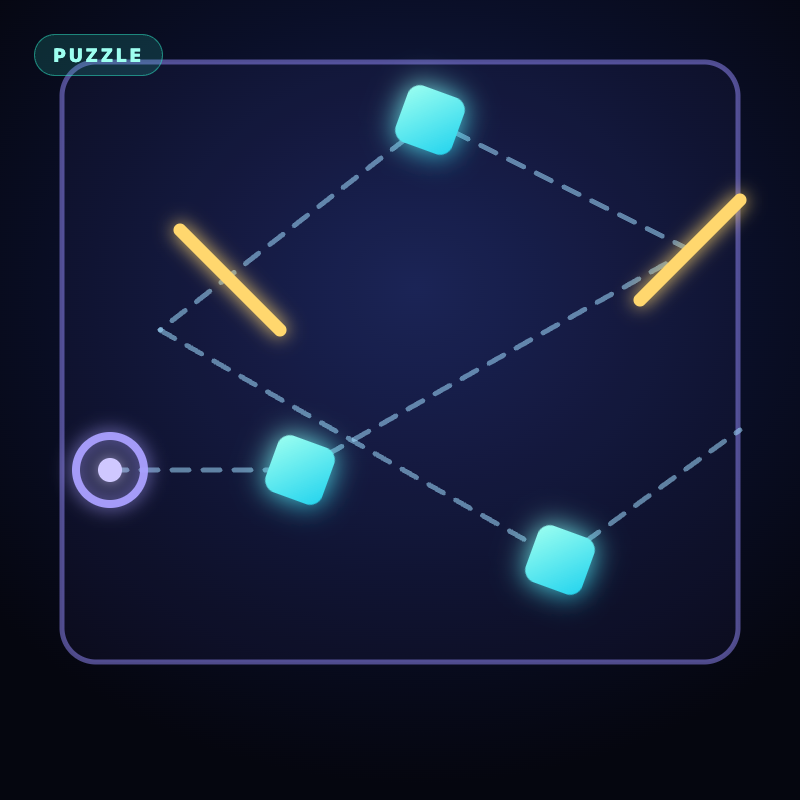
Prism Forge is a light-routing puzzle. Each chamber contains one or more energy sources, a set of cores that need to be lit, and a grid of tiles between them. The tiles are conduits, corners, splitters and gates, and every one of them can be rotated.
Your job is to rotate tiles until a beam travels from each source into every matching core. Each chamber also has a move target, so it is not enough to find a solution — you need an efficient one.
Controls
Tap or click a tile to rotate it. Power-ups are available for hints, undo, shuffle, freeze, blockers, double rewards and extra moves.
Tile types
- Conduits — carry the beam straight through
- Corners — turn the beam 90 degrees
- Splitters — divide one beam into two, letting a single source feed multiple cores
- Gates — conditional tiles that pass or block depending on their state
Understanding what each does is easy. Knowing which to rotate first is the actual puzzle.
Find where the beam stops
The most reliable technique in any light-routing game is to trace from the source. Follow the existing beam until it stops — at a wall, at a wrongly-oriented tile, or by leaving the grid.
That stopping point is where your problem is. Almost every wasted move in this genre comes from rotating tiles further along the intended route, in anticipation of a beam that is not arriving yet. Fix the block, see where the beam stops next, repeat.
This turns a chamber that looks like a wall of possibilities into a sequence of single small decisions.
Work backwards from forced tiles
Some cores can only be entered from one direction — they are against a wall, or tucked in a corner. That means the tile feeding them is forced: there is only one orientation that could possibly work.
Find those first. Forced tiles are free information, and a few of them scattered across the grid give you fixed points to route between, which turns an open-ended problem into a much narrower one. This is the same technique that works in Sudoku and for the same reason: solve the constrained squares before the free ones.
Rotate splitters last
Splitters are the most powerful tile and the biggest source of wasted moves. Because they create two beams, rotating one changes the state of the puzzle in two places at once, and it is very easy to spend five rotations optimising a splitter before you have established that the beam will even reach it.
Build the main route first with conduits and corners. Bring the splitter in once you know where the beam arrives and which two cores you need it to serve.
Watch the move target
The move target is what turns Prism Forge from a routing exercise into a real puzzle. A solution that works but takes twenty rotations over the target is not a solution.
Before committing to a route, roughly count the rotations it will need. If two routes both work, the one with fewer tiles requiring change is better even if it looks less elegant. Players who discover the overrun only at the end tend to have to undo most of their work.
Look for tiles that do double duty
In chambers with multiple sources or multiple cores, the efficient solutions almost always involve a tile that serves two beams at once — a corner that both turns one beam and passes another, or a splitter positioned so its two outputs each land somewhere useful.
If your route nearly works but is a few moves over target, the fix is usually not a rebuild. It is finding one tile that can do two jobs.
Use power-ups deliberately
Hints and undo are limited, which means their value depends on when you spend them. Using a hint on an early chamber you would have solved anyway wastes it; holding it for a chamber where one wrong rotation unravels a long route is where it earns its place.
Undo is particularly valuable on chambers with splitters, where a single rotation can change the whole board state and be genuinely hard to reverse manually.
Why routing puzzles work
Light-routing puzzles sit in a satisfying spot: the rules are visual and immediate, so there is no learning curve, but the solutions require real planning. Because the beam shows you the consequence of every rotation instantly, the game teaches itself — you can always see exactly why your current attempt fails, which is a rare quality in a puzzle game.
Plays on any device
Prism Forge runs in your browser with HTML5 and works on phones, tablets, laptops and desktops. Nothing to install, no signup, and your chamber progress is saved locally.